How we partner with agencies to find great developers
As we evolve our remote team, we are setting what Gemini calls “an unapologetically high bar”. Here is what we expect from the agencies and freelancers we partner with.
Sprend has always been about moving data effortlessly, but how we build the machinery behind the scenes is constantly evolving. As we look toward the future and execute on our long-term vision—which you can read about in Sprend never quits—we realise our true strength lies in agility and working with the best professionals for the specific task at hand.
Today, Sprend operates as a decentralised, remote team. We partner with top-tier freelancers and agencies worldwide. Right now, we are working with incredible web design and copywriting specialists from Croatia to redesign our brand and marketing pages, and soon we will be bringing on new developers to help build our future.
But as we grow this model, we expect our agency partners to do the heavy lifting before a candidate’s name ever crosses my desk.
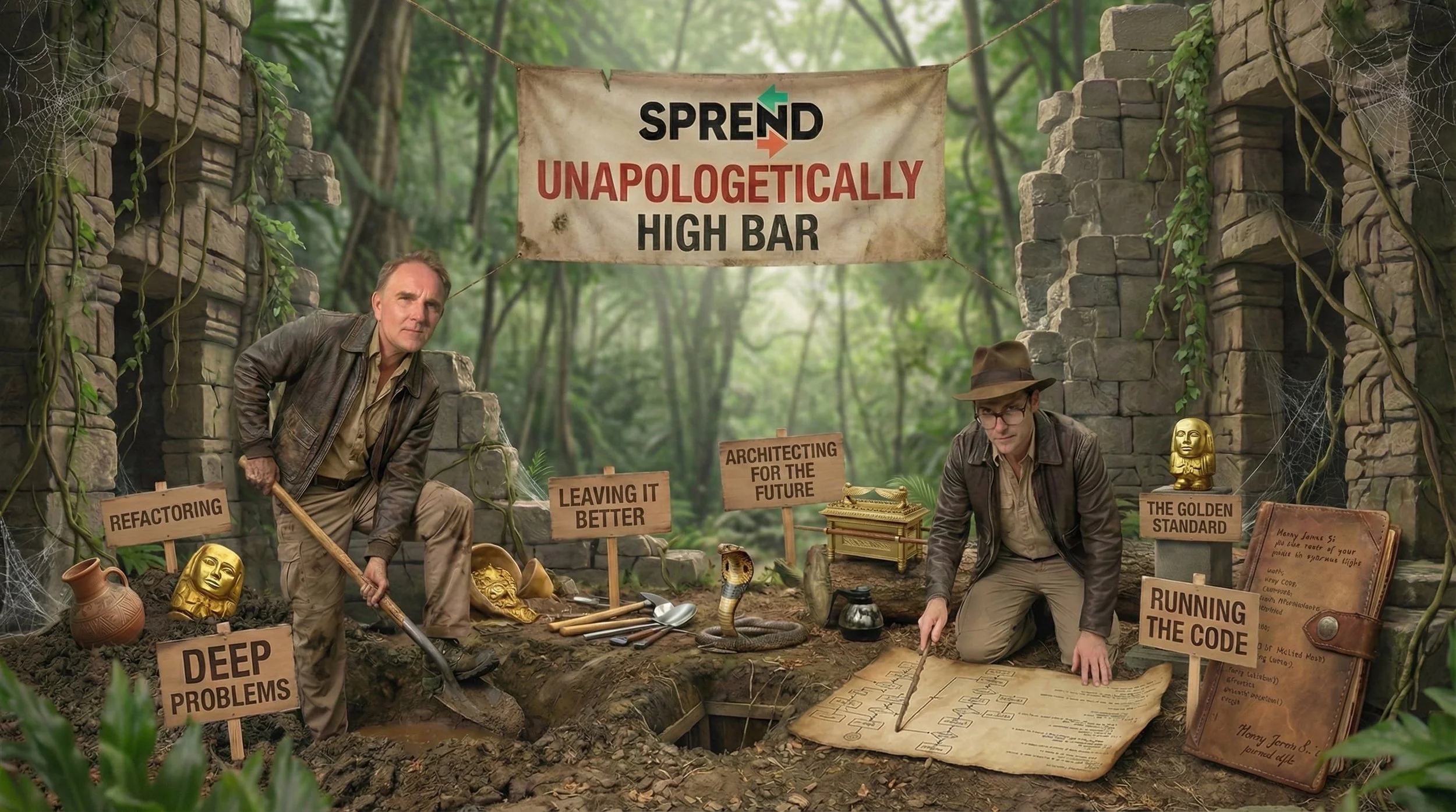
At Sprend, the real treasure is a perfectly understood and refactored piece of legacy code.
The checklist
At Sprend, we respect craftsmanship. We do not ask elite developers to jump through hoops before we have proven our interest. We expect agency partners to follow this order.
Phase 1: Cultural vetting
This phase is about proving the candidate is a Sprend-fit before a single line of code is discussed.
☑️ DNA Evidence: You have spoken to at least 3 former colleagues and have gathered specific, verifiable anecdotes for our 11-point Professional DNA. We want stories of "battle," not standard 1–5 ratings. Read more in the section below.
Phase 2: The multi-stage pitch
This is the core filter. Interest must be established before effort is requested.
☑️ Step 1: Pitch the dev to me. The agency’s technical lead calls me on Signal (+46 70 714 52 99) to pitch the candidate based on the DNA Evidence. Convince me why they are a perfect match. Do not reveal the project details to the developer yet.
☑️ Step 2: Pitch the project to the dev. Only after I am convinced by your pitch and give the green light, you present the Sprend vision and the specific project to the developer. Get them genuinely excited.
Phase 3: Selection
Now that mutual interest is confirmed, we request the developer’s time.
☑️ Technical Proof: If the developer is excited about the project, now is the time for your agency’s technical lead to verify their craft. You must watch the candidate step through code line-by-line (Asynchronous JS is our benchmark, see below).
☑️ Chemistry check: If they pass the technical verification, arrange a video call between the developer and me. This is for vibe and vision alignment—not a technical interrogation.
☑️ The Sprend Challenge: If we "click" on the video call, we move to the ultimate question: The Sprend Challenge: Do we actually enjoy working together?
Our 11-point Professional DNA
Technical skills are just the baseline. We aren't just looking for people to close tickets; we want craftsmen who fit the unique rhythm of our company (to get a feel for our internal culture, read this).
Before submitting a profile, the agency must interview three people who have worked alongside the developer. If the dev doesn’t have extensive experience, the agency could talk to university professors and classmates, read their blog posts, and check out GitHub repos.
As an agent, before the interviews, make sure you understand each of the following eleven points. It helps a lot if you have experience working in a software development team. Don’t settle for yes or no answers; ask for specific, verifiable stories.
They own the task: They’ve seen too many times team members who don’t take the task to completion. It could be someone who is “only the backend dev” and won’t touch the frontend code. It could be a project manager who lets another project’s problems dictate our success. The number one takeaway lesson from all writing on Agile methodology is to finish the current task before starting the next.
Deadlines hurt customers: A deadline is a very blunt tool, often based on the idea that pressuring people yields better results. It doesn’t. The result is a lower-quality product in every aspect, ultimately making the customer less productive. They know this and will fight for it.
Readable code is the foundation for great UX: They are naturally detail-oriented. They care about code readability and solid architecture throughout the tech stack and beyond, into the user experience. They build the app they want to use themselves.
Refactoring is not an afterthought: It’s tempting: let’s just do some “bypass surgery” here. But no, why would one increase the complexity of a system? Rather, the code they commit is better structured than it was found. Refactoring is what they do as part of every task.
Digging deep: So they fixed the problem, but it was just too easy. That’s why they dig deeper. They make sure you understand what is really going on and fix the real problem.
Schrödinger’s code: They know that untested code is exactly like Schrödinger’s cat: until you run the test and "open the box," your feature is simultaneously working and completely broken. Nobody needs to remind them to write tests.
Communicating freely: It’s a remote team. I would prefer it if I could roll my chair over to their desk to instantly double our intelligence. Since we can't, everyone has to proactively communicate—before, during, and after a task is implemented. In the team we talk about ideas, problems, and great solutions.
Low ego, high standards: I’m going to fix their code. They are going to fix mine. Let’s welcome feedback. Let’s learn together.
Pragmatic judgment: Every new tool or framework comes with a cost. As one thing becomes easier to achieve, another one becomes harder. They are pragmatic enough to choose the “boring,” stable tech over a trendy, hyped-up one because it is the smartest, most reliable choice for the product's long-term health.
Technology is but a tool (the goal is productivity and joy): We build software to help people climb the Maslow Pyramid: we aim for our users to feel more confident, connected, creative, proud, and respected.
Attitude and humour: They love software development. So do we. Our attitude is to have fun, let’s have a laugh. Let’s work magic together.
Technical proof: Running the code
At Sprend, trial-and-error coding isn't enough. We need developers who understand the deep mechanics of the language they are using. Therefore, before presenting a candidate, the agency must perform a rigorous technical screen. We expect the agency’s technical lead to run a practical test—for example, fixing a bug in asynchronous JavaScript code—and verify that the candidate can manually “run” their code. The candidate must be able to step through the logic line by line, explaining exactly how the execution works, what values variables hold, and how errors are caught and handled. The ability to read code has always been important; in an age of AI assistants, it is even more important.
Read about our tech stack.
Thoughts
This post is a work in progress. I’m trying to learn how to recruit great developers. Please leave feedback!